
Alle Beiträge
-
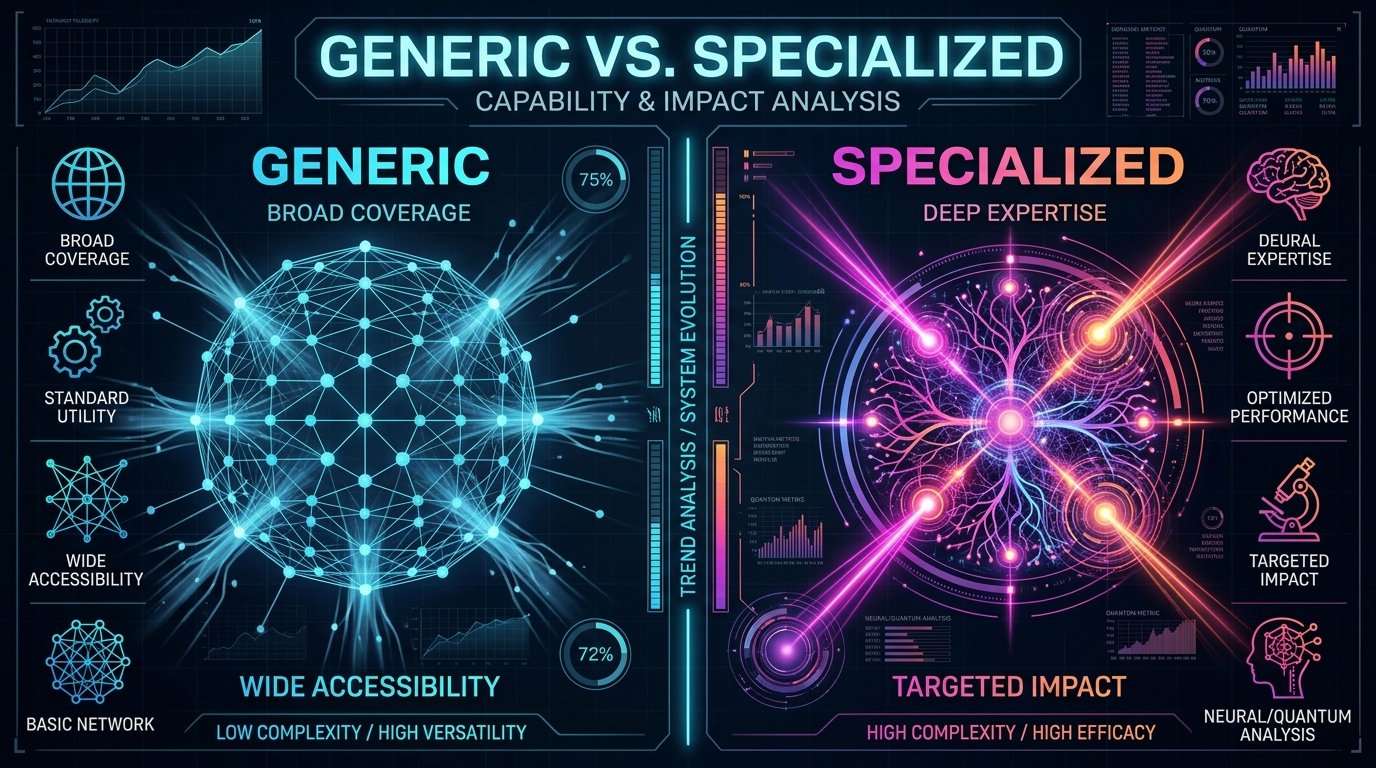
Generic vs. Specialized: The Architectural Decision for Autonomous Agents
Generic vs. Specialized: The Architectural Decision for Autonomous Agents Executive Summary C-suite leaders commissioning autonomous consulting AI face a critical architectural decision: should the system be a generalist that learns every task, or a portfolio of specialists optimized for bounded workflows? This choice determines vendor lock-in, risk exposure, cost trajectory, and the organization’s ability to
-

·
Trust-by-Design Framework for Autonomous Advisory Systems
Trust-by-Design Framework for Autonomous Advisory Systems Executive Summary Organizations deploying autonomous advisory systems face a critical constraint: $2.5–$5 million in average post-deployment remediation costs when trust failures trigger regulatory investigations or client disputes, according to industry risk assessments.[17][36] This cost, combined with board-level risk aversion and regulatory uncertainty, is stalling AI pilot expansions even where
-

RAG³ Explained: Knowledge Base for Agents
Executive Summary Enterprise AI agents face a fundamental constraint: context window limitations render most theoretical capacity unusable in practice. Retrieval-Augmented Generation (RAG) systems address this by functioning as external memory that agents query on-demand, connecting them to knowledge bases. Agentic RAG implementations—where AI agents actively query, refine, and synthesize information—outperform traditional single-step retrieval in complex
-
Governance according to ISO 42001: AI Management for Autonomous Consulting Systems
Executive Summary Autonomous multi-agent consulting systems represent a fundamental shift from passive AI tools to self-coordinating digital workforces that shape client outcomes, manage complex workflows, and interface directly with enterprise data.[17] This transformation demands a new governance paradigm. ISO/IEC 42001, the world’s first international standard for Artificial Intelligence Management Systems (AIMS), provides that framework—specifying how
-

Autonomy vs. Control: The Governance Dilemma of Autonomous AI Systems
Executive Summary Organizations deploying autonomous AI agents face a fundamental governance paradox: maximizing autonomy drives efficiency gains but introduces operational risks that traditional oversight can’t contain. Evidence shows a persistent maturity gap—only 30% of enterprises have adequate governance controls for agentic AI despite accelerating deployment timelines[2]. Competitive advantage goes to organizations that maximize verified autonomy
-

·
ISO 42001 for Executives: Turning AI Governance from a Cost Center into a Competitive Advantage
ISO 42001 for Executives: Turning AI Governance from a Cost Center into a Competitive Advantage Executive Summary ISO 42001 certification transforms AI governance from regulatory burden into measurable competitive advantage. Organizations achieving certification report quantifiable outcomes: Rocket Mortgage saved 40,000 annual hours ($1.9–$2.4 million) through compliant automation, Boston Consulting Group positioned as “the only premium
-

The Agent-Skill Illusion: Why Prompt-Based Control Fails in Multi-Agent Business Consulting Systems
The Agent-Skill Illusion: Why Prompt-Based Control Fails in Multi-Agent Business Consulting Systems Executive Summary Organizations deploying autonomous multi-agent systems for business consulting face a critical reliability gap. Current systems fail to execute even well-specified tasks consistently: agents produce 2–4 distinct action sequences for identical inputs, with accuracy plummeting from 80–92% in consistent scenarios to 25–60%
-

Beyond the Hype: 3 Actionable Use Cases for Multi-Agent Systems in Business
Beyond the Hype: 3 Actionable Use Cases for Multi-Agent Systems in Business Executive Summary Multi-agent systems compress supply chain response from hours to 15 minutes, reduce loan underwriting from days to hours, and cut IT ticket handling by 20–30 percent—but only when organizations redesign workflows and embed runtime governance. By early 2026, 23 percent of
-

Is VS Code Copilot the Most Powerful AI Agent? Not only Code Related but in General?
Executive Summary No single AI coding agent dominates across all enterprise workflows. Agent performance depends more on task type and organizational maturity than vendor selection. A comparative analysis of 7,156 pull requests reveals a 29 percentage-point performance gap between best and worst task categories (documentation at 82.1% versus configuration at ~53%) compared to only
-

From ‘Black Box’ to ‘Glass Box’: A Practical Guide to Building Trust in Autonomous AI
Executive Summary Trust has become the defining competitive advantage in autonomous AI adoption. McKinsey’s 2026 survey reveals that only 30 percent of organizations achieve maturity level three or higher in agentic AI controls, while nearly two-thirds cite security and risk concerns as the top barrier to scaling.[5] This trust deficit shows up as delayed