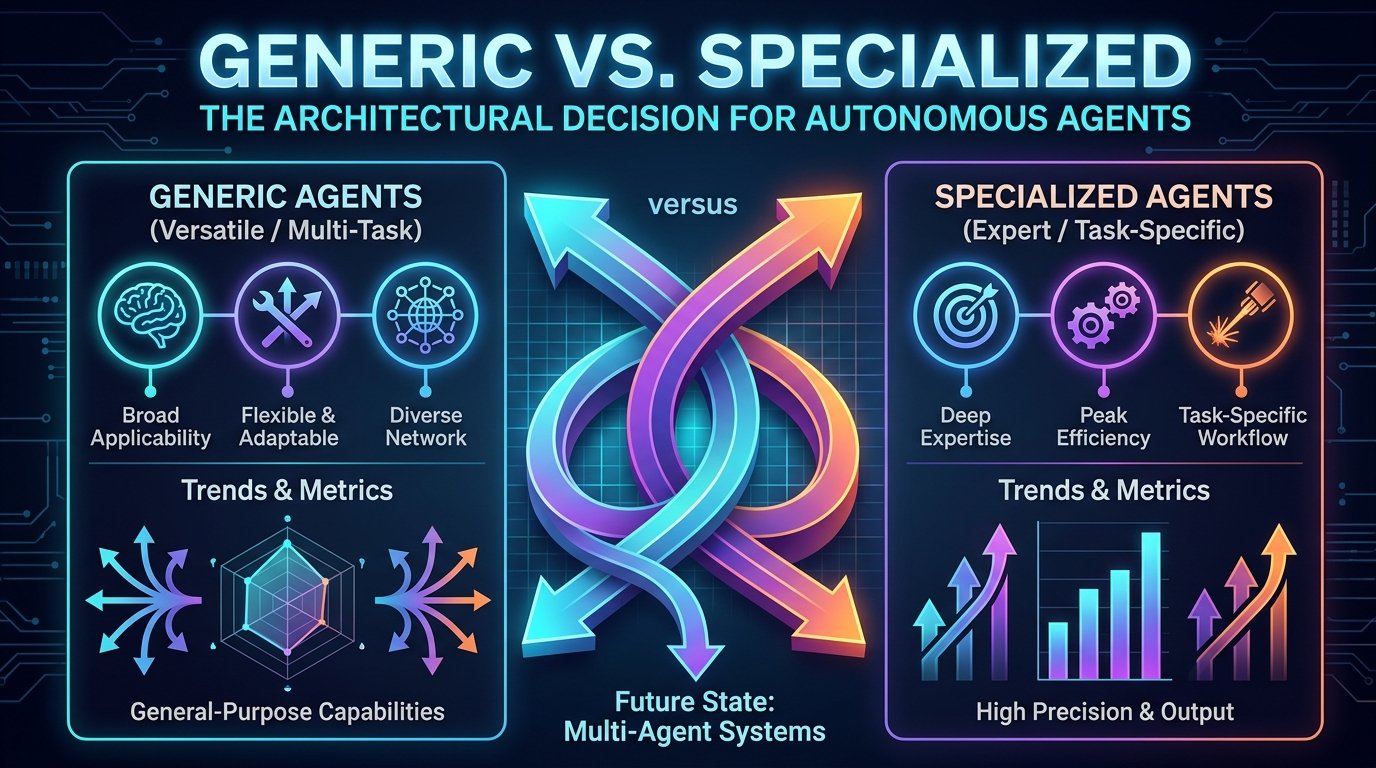
Generic vs. Specialized: The Architectural Decision for Autonomous Agents
Executive Summary
C-suite leaders commissioning autonomous consulting AI face a critical architectural decision: should the system be a generalist that learns every task, or a portfolio of specialists optimized for bounded workflows? This choice determines vendor lock-in, risk exposure, cost trajectory, and the organization’s ability to measure ROI. Getting it wrong means either underperforming single-agent baselines or building unmaintainable complexity.
Evidence from 260 controlled configurations demonstrates that multi-agent systems (MAS) produce outcomes ranging from +80.8% improvement on decomposable financial reasoning to −70.0% degradation on sequential planning tasks [1]. This variance signals a critical governance requirement: architecture must follow task topology, not technology fashion. Domain specialization creates competitive advantage through proprietary knowledge, terminology, decision rules, and tools—but not necessarily through custom foundation models. BloombergGPT combined 363 billion financial tokens with 345 billion general tokens, outperforming comparable models on financial tasks without sacrificing general capability [2].
The business case is conditional. In a preregistered study of 758 consultants, GPT-4 users completed 12.2% more tasks and worked 25.1% faster inside the model’s capability frontier—but were 19% less likely to solve outside-frontier management problems correctly [3]. Enterprises that segment autonomy and measure baselines achieve 10–30% labor-adjusted productivity gains; those that deploy without task-specific validation risk negative ROI due to error correction and rework. The defensible operating model is central orchestration, specialized bounded workers, independent verification, human ownership of consequential decisions, portable model interfaces, and baseline-to-intervention measurement.
Introduction
The decision to build autonomous consulting AI as a generalist or as a collection of specialists is not primarily a technical question. It’s a risk and governance question with direct implications for vendor lock-in, operational cost, and the ability to defend outcomes to clients and regulators. Leaders who frame this as a pure technology choice will optimize for architectural elegance rather than measured business value.
The choice matters now because model proliferation, declining inference costs, and the emergence of multi-agent orchestration frameworks have made autonomous consulting architectures economically viable—but not automatically valuable. Early enterprise implementations reveal a pattern: systems that match architecture to task structure deliver measurable gains, while those that apply multi-agent complexity to unsuitable workflows introduce coordination overhead that overwhelms any benefit.
This article translates controlled research and operational case studies into actionable decision criteria. It establishes when a single capable agent should remain the default, when specialization creates value, where domain knowledge should reside, and how to segment autonomy by consequence. The architectural recommendations assume minimum organizational prerequisites: governance capacity, historical engagement data, consultant adoption, client acceptance, and technical infrastructure. Enterprises lacking these capabilities should treat autonomous consulting AI as a research initiative, not a production deployment. The technology isn’t the constraint—organizational readiness is.
The Topology Principle: Task Structure Determines Architecture
Plain translation: The strongest predictor of success is whether the work can be broken into independent pieces that can be checked separately—not how many agents you deploy.
The strongest predictor of multi-agent system performance is not agent count, model size, or domain specificity—it’s task topology. Research examining 260 configurations across multiple architectures found that systems designed for decomposable workflows with independent verification delivered substantial gains, while those applied to tightly coupled sequential tasks introduced coordination overhead that overwhelmed any benefit [1]. Performance ranged from +80.8% improvement on financial reasoning tasks to −70.0% degradation on sequential planning workflows.
This finding contradicts the vendor narrative that “more agents equals more intelligence.” In practice, adding agents introduces additional prompts, state transfers, failure points, latency, and token consumption. A study analyzing more than 1,600 execution traces across seven frameworks identified multiple failure modes, including system design flaws, inter-agent misalignment, and weak task verification [4]. These aren’t edge cases. They’re predictable consequences of architectural complexity applied to the wrong task structure.
The implication for enterprise architecture is surgical: decompose only where decomposition creates value. Suitable candidates include research-and-synthesis workflows where one agent retrieves sources, another validates factual claims, and a third drafts client-facing narratives. Unsuitable candidates include strategic-planning workflows where context must remain coherent across multiple reasoning steps, and where premature decomposition fragments the decision space.
Domain specialization follows similar logic. Specialization creates value when agents represent genuinely different competencies, permissions, or risk profiles—not merely different narrative roles. A research agent with access to external databases, a regulatory-review agent with jurisdiction-specific rule sets, and a quantitative-analysis agent with code-execution privileges represent meaningful specialization. Three “strategist” agents with identical models, tools, and permissions represent cosmetic role-playing that adds communication cost without diversity of capability [5].
Vertical Specialization: Where to Encode Domain Knowledge
The normal progression for domain specialization should be: general model → domain retrieval → approved tools → structured decision rules → specialist prompts and adapters → fine-tuning → domain pre-training only if earlier approaches fail. Most consulting enterprises will never reach the final step—and shouldn’t need to.
BloombergGPT demonstrates both the potential and the barrier of domain-specific foundation models. Its 50 billion parameters were trained on 708 billion tokens, combining 363 billion financial tokens with 345 billion general tokens [2]. The result outperformed comparable models on financial tasks without sacrificing general competence. Yet the scale of investment required—data pipelines, computational infrastructure, and the specialized talent to execute—places this approach beyond the reach of all but the largest financial institutions and technology firms.
For consulting enterprises, the defensible specialization strategy is to protect competitive advantage in context, evaluation data, ontologies, workflows, and tools—not in dependency on a single foundation-model API. This approach maintains portability across model providers, reduces vendor lock-in, and concentrates investment in assets that the firm controls.
Retrieval-augmented generation (RAG) should be the default starting point. RAG systems pull approved client data, firm knowledge, and authoritative external sources into the generation context, enabling domain fluency without retraining the underlying model. The competitive advantage resides in curated knowledge, metadata structures, and retrieval policies—not in the embedding model, which can be swapped as better options emerge.
Tool specialization follows next. A consulting agent with access to approved databases, spreadsheet environments, document-production systems, and project-management tools becomes domain-capable through its interactions, not through its weights. Tools should use least privilege, typed inputs, transaction limits, and sandboxing to prevent unintended consequences.
Only after exhausting these approaches should enterprises consider fine-tuning or domain-specific pre-training. The burden of proof is economic: will custom weights deliver quality or cost improvements sufficient to justify the investment, ongoing maintenance, and reduced portability? In most consulting contexts, the answer is no.
Workflow Redesign and Change Management
Architectural success depends on workflow redesign, not just technical deployment. In a 2026 survey of 1,719 respondents across 97 countries, only 37% reported positive EBIT contribution. Nearly three-quarters of high performers had fundamentally redesigned workflows, versus one-quarter of other respondents [10]. The highest-value opportunities require rethinking the consulting engagement model itself: from sequential handoffs to parallel execution with centralized verification; from opaque expert judgment to evidence-backed reasoning with traceable sources; from billable hours to outcome-based pricing. Technology teams should own the platform; business leaders should own the outcome and redesigned process.
ISO Alignment (Management Perspective)
Two ISO standards materially improve decision guidance for autonomous consulting architectures: ISO 20700 (consulting quality and engagement governance) and ISO 42001 (AI governance, accountability, and risk management).
ISO 20700 (Consulting Services)
Management intent: ISO 20700 ensures that autonomous consulting systems maintain the same quality, engagement clarity, and client accountability standards required of human consultants. Leaders should care because client trust, contractual defensibility, and professional liability depend on documented quality assurance—not on the sophistication of the underlying AI.
Minimum practices (management level):
– Define engagement scope, deliverables, and acceptance criteria before granting autonomous agents authority to produce client-facing outputs.
– Establish a documented quality-assurance process that includes independent review of AI-generated recommendations.
– Maintain engagement records that capture prompts, model versions, retrieved sources, tool calls, and human approvals—enabling post-engagement reconstruction.
– Assign a named accountable individual for each engagement who retains authority to approve, modify, or reject AI-generated deliverables.
Evidence/artifacts: Engagement charter template documenting scope, boundaries, and approval authority.
KPI: Client acceptance rate for AI-generated work (target: ≥95% first-pass acceptance without material rework).
Risk + mitigation:
Risk: Autonomous agents produce deliverables that fail client acceptance criteria, creating rework or liability exposure.
Mitigation: Require independent verification by a qualified human reviewer before releasing any consequential recommendation or client-facing strategic analysis.
ISO 42001 (AI Management System)
Management intent: ISO 42001 establishes governance roles, risk management processes, and continual-improvement cycles that enable executives to maintain accountability and control over autonomous AI systems. Leaders should care because regulatory expectations and fiduciary duty require demonstrable governance—not a statement that “the AI made the decision.”
Minimum practices (management level):
– Assign a named AI system owner with authority to approve deployments, set autonomy tiers, and order system suspension if risk thresholds are breached.
– Establish a risk-based autonomy segmentation framework that restricts fully autonomous operation to low-consequence, high-verifiability workflows.
– Implement continuous monitoring of model performance, data drift, and control effectiveness, with automatic demotion to supervised mode when thresholds are breached.
Evidence/artifacts: AI system register documenting each autonomous workflow’s purpose, risk classification, and named accountable owner.
KPI: Autonomy tier compliance (target: 100% of consequential workflows operating within approved autonomy limits).
Risk + mitigation:
Risk: Autonomous system produces an incorrect or non-compliant output that creates client harm or regulatory exposure—and no accountable individual can explain why the system made that decision.
Mitigation: Separate generation from verification; maintain evidence logs that capture prompts, model version, and reasoning traces; assign a named decision owner who retains authority to override system outputs.
Implications for the C-Suite
Decision Framework: When to Choose Generic vs. Specialized Architecture
The most valuable—and riskiest—decisions are autonomy segmentation (step 3) and baseline measurement (step 4). Enterprises that deploy without these controls risk negative ROI regardless of architectural sophistication.
-
Start with the simplest viable agent.
– Decision rule: Default to a single capable agent with retrieval and approved tools before considering multi-agent decomposition.
– Controls: Require an architecture decision record for every proposed multi-agent workflow, documenting decomposition logic, dependency graph, verifier design, and a single-agent benchmark that the MAS must exceed on quality-adjusted total cost of ownership.
– Metric: Quality-adjusted cost per accepted case (target: MAS must achieve ≥10% improvement over single-agent baseline to justify deployment). -
Add specialists only when justified by distinct competencies.
– Decision rule: Promote a specialist agent only when it represents a genuinely different competency, permission, or risk profile. Remove agents that don’t improve measured outcomes after two review cycles.
– Controls: Require each agent to have documented purpose, unique inputs or permissions, acceptance criteria, and shutdown conditions.
– Metric: Incremental quality gain per specialist agent (target: each specialist must contribute ≥5% quality improvement or ≥15% cost reduction). -
Segment autonomy by consequence and empirical capability.
– Decision rule: Establish autonomy tiers with promotion and demotion thresholds. Reserve fully autonomous operation for low-consequence workflows with proven accuracy; require human approval for strategic recommendations, client commitments, and material financial conclusions.
– Controls: A model upgrade, material data drift, or control failure should automatically return the workflow to shadow or approval mode until re-qualified. Quarterly management review of autonomy-tier compliance and incident rates.
– Metric: Autonomy tier compliance rate (target: 100%); critical control-failure incident rate (target: zero per quarter). -
Measure against operational baselines, not vendor demonstrations.
– Decision rule: Capture at least four weeks of pre-deployment telemetry before claiming ROI. Count labor value only when capacity is redeployed, avoided, billed, or removed—time theoretically saved but absorbed by meetings or rework is not a cash benefit.
– Controls: Use randomized or staggered rollout designs where feasible; blind quality evaluation where consequence is material; independent verification of cost and time measurements.
– Metric: Realized ROI based on redeployed capacity, incremental margin, and avoided loss (target: ≥15% realized ROI within 12 months).
Recommended First Steps (30 Days)
For CTO/CDO leaders ready to act:
-
Select one high-volume, bounded workflow and map its current cycle time, labor cost, defect rate, and client acceptance criteria. Workflows suitable for early testing include research synthesis, document drafting, data extraction, regulatory pre-screening, or project-status reporting.
-
Build a single-agent-plus-tools baseline using an existing model provider (OpenAI, Anthropic, Google) with retrieval and approved tools. This establishes the performance threshold that any multi-agent architecture must beat.
-
Define a gold test set from 20 to 50 historical client engagements, with blinded quality scoring by experienced consultants who don’t know which outputs are human-generated versus AI-generated.
-
Establish quality and cost thresholds that the system must meet before approval for shadow deployment: target ≥90% quality match to human baseline, ≤50% of human labor cost, and zero critical control failures during testing.
Conclusion
The architectural decision between generic and specialized AI agents isn’t a one-time technology choice. It’s a continuum of design decisions, each governed by evidence of task topology, economic justification, and measured baseline performance. The strongest defensible architecture is vertical, modular, and conservative: default to the simplest viable agent, add specialists only where workflows are decomposable and independently verifiable, invest in portable specialization layers rather than foundation-model dependencies, and promote autonomy only after empirical validation against controlled baselines.
Controlled research establishes both the value potential and the governance requirement. Multi-agent systems can deliver substantial gains on decomposable workflows—but degrade performance on sequential tasks requiring tight state coherence. Domain specialization creates competitive advantage—but should reside in retrieval, tools, and evaluation rather than custom foundation models. Productivity evidence is promising—but conditional on task-specific capability mapping and independent quality checks.
Enterprises that segment autonomy by consequence, capture operational baselines, separate generation from verification, and maintain portable architectures achieve 10–30% labor-adjusted productivity gains within 12 months. Those that pursue architectural elegance without empirical validation discover that complexity compounds risk rather than reducing it. The three conditions that determine success are task decomposability, baseline measurement discipline, and independent verification weighted by consequence. The riskiest failure mode is autonomy without consequence-based segmentation—where the system is granted decision authority over strategic recommendations, client commitments, or material financial conclusions without human oversight.
Public evidence doesn’t yet provide a critique-proof, longitudinal case of an end-to-end autonomous multi-agent consulting firm with disclosed baseline, implementation cost, incidents, and three-to-five-year TCO. That gap is a research opportunity—not an invitation to proceed without evidence. The business case for autonomous consulting AI is not a question of whether to adopt agents, but how to earn trust through measured performance.
References
[1] Agent Swarms. “Why Do Multi-Agent LLM Systems Fail?” Agent Swarms Blog. https://agentswarms.fyi/blog/why-do-multi-agent-llm-systems-fail
[2] arXiv. “BloombergGPT: A Large Language Model for Finance.” arXiv Preprint. https://arxiv.org/html/2605.03310
[3] The Internet Ninja. “BCG Harvard Jagged Frontier: GPT-4 Consultants Complete 12.2% More Tasks (2023).” https://theinternetninja.com/stories/bcg-harvard-jagged-frontier-gpt4-consultants-12-2pct-more-tasks-2023/
[4] DBLP. “Cemri et al., NeurIPS 2025: Multi-Agent System Failure Modes.” DBLP Computer Science Bibliography. https://dblp.org/rec/conf/nips/CemriPYACTKPKRZ25
[5] ACM Digital Library. “Multi-Agent System Design Dimensions: Profiling, Communication, Skill Development, Environment and Evaluation.” ACM IJCAI Proceedings. https://dl.acm.org/doi/10.1145/3848128
[6] ACM Digital Library. “Generative AI and Customer Service: Productivity Gains for Novice Workers.” Computers & Industrial Engineering, 2026. https://dl.acm.org/doi/10.1016/j.cie.2026.111915
[7] ACM Digital Library. “AI-Assisted Development: Measured Productivity Effects in Randomized Trials.” ACM Conference Proceedings, 2025. https://dl.acm.org/doi/10.1145/3770855.3818485
[8] ACM Digital Library. “RouteLLM: Cost Reduction Through Model Routing.” ACM Conference Proceedings. https://dl.acm.org/doi/10.1145/3776574.3831126
[9] ACM Digital Library. “FrugalGPT: Inference Cost Optimization Without Quality Compromise.” ACM Conference Proceedings. https://dl.acm.org/doi/10.1145/3788550.3794886
[10] McKinsey & Company. “The State of AI in 2026: Enterprise Scaling and EBIT Contribution.” McKinsey QuantumBlack Insights. https://www.mckinsey.com/capabilities/quantumblack/our-insights/the-state-of-ai
[11] Boston Consulting Group. “Agents Accelerate the Next Wave of AI Value Creation.” BCG Publications, 2025. https://www.bcg.com/publications/2025/agents-accelerate-next-wave-of-ai-value-creation
Image Prompts
Image 1: Task Topology Decision Tree
Create a clean, executive-level decision flowchart showing how task characteristics determine architecture choice. Start with “Consulting Task” at top, branch into “Is work decomposable into independent subtasks?” (yes/no), then “Can outputs be independently verified?” (yes/no), then “Does coordination overhead exceed single-agent baseline?” (yes/no), leading to terminal nodes: “Multi-Agent Architecture Justified” (green), “Single Agent + Tools Recommended” (blue), or “Reject MAS—High Risk” (red). Use a minimal color palette (navy, green, red, white), sans-serif typography, and clear directional arrows. Include small icons: puzzle pieces for decomposability, checkmark-shield for verification, clock-warning for overhead.
Image 2: Vertical Specialization Stack
Create a layered architecture diagram showing the specialization progression for consulting AI, viewed as a vertical stack from bottom to top. Bottom layer: “Foundation Model” (generic, labeled “GPT-4 / Claude / Gemini”). Next layer up: “Domain Retrieval” (firm knowledge, client data, approved sources—labeled with document and database icons). Next: “Tool Layer” (spreadsheet, code execution, CRM integrations—labeled with tool icons). Next: “Policy & Decision Rules” (governance constraints, jurisdiction rules—labeled with shield icon). Top layer: “Specialist Agents” (Research, Regulatory Review, Quantitative Analysis—labeled with role icons). Use a clean, modern style with subtle gradients, arrows showing data flow upward, and a color progression from cool gray (foundation) to strategic blue (specialists). Include a side annotation: “Competitive advantage resides here” pointing to the middle three layers, not the foundation model.